Short answer: Warhammer 40K (Warhammer 40,000) is a tabletop miniature wargame first published by the British company Games Workshop in 1987, and the gothic sci-fantasy universe around it. Set in the 41st and early 42nd millennium, it pits a decaying human Imperium against Chaos and alien races. Players collect, build, paint and battle with miniatures.
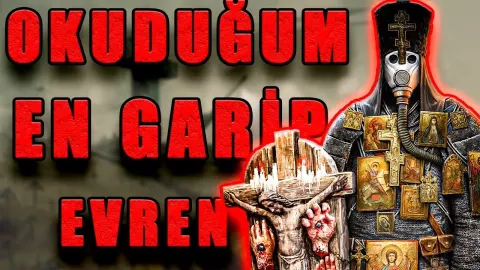
The video above is a Turkish-language video by MOZEKUMA. It walks through the setting's history in chronological order, from the Warp to the Horus Heresy. We summarise the lore in our own words, then move on to what the video doesn't cover: how the game is played, what to buy first, and why painting the miniatures is half the fun.
What is Warhammer 40K and where did it come from?
Warhammer 40K started as the science-fiction sibling of Games Workshop's fantasy game, Warhammer Fantasy Battle. The first rulebook, Warhammer 40,000: Rogue Trader, came out in autumn 1987, with rules written by Rick Priestley.
Wikipedia describes Warhammer 40,000 as "the most popular miniature wargame in the world", with a particularly strong following in the United Kingdom.
Source: Warhammer 40,000, Wikipedia
Because of its fantasy roots, the universe has magic, elf-like and orc-like races, and daemons, all mixed with starships, giant war machines and planet-sized cities that look like cathedrals. The usual label is "gothic sci-fantasy". The setting is also one of the founding works of "grimdark" fiction, a genre named largely after the game's famous tagline.
"In the grim darkness of the far future, there is only war."
The official Warhammer 40,000 tagline used by Games Workshop for decades.
What inspired Warhammer 40K?
- Science fiction and fantasy: Frank Herbert's Dune (a vast empire, religion and psychic powers), H.P. Lovecraft's cosmic horror, Michael Moorcock's Law and Chaos, and Tolkien's elves and orcs.
- Space Marines: the powered-armour infantry and orbital drop capsules of Robert A. Heinlein's Starship Troopers, ancestors of the game's drop pods.
- Comics: the British magazine 2000 AD and the darkly satirical authoritarian world of Judge Dredd.
- History and art: medieval and Baroque art, Imperial Rome, the Inquisition and imagery from the world wars.
These roots show up on the miniatures too. The skulls, purity seals and scrollwork on Space Marine armour echo illuminated manuscripts, while Astra Militarum infantry in greatcoats look like First World War soldiers. Old-world colours such as brass, bone and deep red always sit well in this setting.
What is the Warhammer 40K lore about?
The classic era is the 41st millennium, roughly the year 40,000 AD, which is where the "40K" comes from. The current storyline has moved into the early 42nd millennium after the Great Rift tore the galaxy in two. The video's chapters follow the history in order, and so do we.
What is the Warp and who are the Chaos Gods?
The Warp (also called the Empyrean, the Immaterium or the Sea of Souls) is a psychic dimension made of thought and emotion that sits alongside real space. Starships cross it to travel faster than light, but it is home to daemons and four Chaos Gods who feed on mortal emotion:
- Khorne: war, rage and slaughter.
- Tzeentch: change, scheming and deceit.
- Nurgle: decay, disease and a strangely fatherly despair.
- Slaanesh: pleasure, excess and pride. The youngest; its birth comes later in the story.
Who are the Necrons and what was the War in Heaven?
Long before humanity, the short-lived Necrontyr lived under a deadly sun. The star-eating C'tan promised them immortality, then consumed their souls and moved their minds into metal bodies. That is how the Necrons were born. The C'tan drove them against the ancient Old Ones in the War in Heaven. In the end the Silent King, Szarekh, turned on the C'tan and shattered them, and the Necrons went to sleep in their tomb worlds. Now they are waking up.
Who are the Eldar (Aeldari) and why did they fall?
The Old Ones created other races to fight the Necrons. The most important were the Eldar, now called the Aeldari: long-lived, highly psychic "space elves" whose Webway let them cross the galaxy without entering the Warp. In time their empire sank into endless indulgence, and that excess gave birth to Slaanesh, who devoured most Aeldari souls in an event called the Fall. Survivors fled on vast Craftworlds; others went down a darker path and became the Drukhari.
What were the Dark Age of Technology and the Age of Strife?
Meanwhile humanity spread across the stars during the Dark Age of Technology, helped by thinking machines and Navigators who could steer through the Warp. The revolt of the Men of Iron and the Warp storms unleashed by Slaanesh's birth wrecked it all, cutting worlds off from one another for thousands of years. This was the Age of Strife. It also produced pieces of the future Imperium: the feudal Knight Worlds and the machine-worshipping tech-priests of Mars, the Adeptus Mechanicus.
Who is the Emperor and what are the Primarchs?
On Terra, an immortal psyker who had hidden among humans for millennia stepped forward: the Emperor of Mankind. According to the lore he was born in Anatolia, modern Turkey. He won the Unification Wars with his Thunder Warriors, allied with Mars and founded the Imperium of Man.
He then created twenty sons from his own genetics, the Primarchs. Chaos scattered them across the galaxy, so the Emperor launched the Great Crusade to find them and reclaim lost worlds. Each Primarch's gene-seed founded a Legion of Space Marines (the Adeptus Astartes), such as Leman Russ's Space Wolves and Rogal Dorn's Imperial Fists. Two Primarchs and their Legions were erased from all records, one of the setting's great mysteries.
Why is the Horus Heresy so important?
Horus, the Emperor's favourite son and Warmaster, fell to Chaos and took nearly half the Primarchs with him. The civil war ended at the Siege of Terra, where the Emperor slew Horus aboard his flagship but was mortally wounded. The Horus Heresy, fought in the 31st millennium, is the defining event of 40K history and the subject of a long novel series. Almost every grudge in today's galaxy starts here.
What is the galaxy like now?
Since then the Emperor has sat on the Golden Throne, neither dead nor alive. His mind powers the Astronomican, the psychic beacon that guides ships through the Warp, and according to the lore hundreds of psykers are sacrificed each day to sustain him (the number varies between sources). Ten thousand years on, the Imperium worships him as a god: a xenophobic, merciless theocracy. Its enemies are also the armies you can play:
- Chaos Space Marines: descendants of the traitor Legions.
- Orks: green, war-loving hordes.
- Tyranids: the Great Devourer, a swarm from beyond the galaxy.
- Necrons: undying machine armies.
- Aeldari: survivors of a fallen empire.
- T'au: a young, high-tech empire expanding for the Greater Good.
The setting's core themes are decline and intolerance. Every great power once ruled the galaxy and is now a shadow of itself. There are heroes, but no good guys.
How do you play Warhammer 40K?
For all its lore, 40K is first a tabletop wargame. The basic loop is simple:
- Build an army: every unit has a points cost, and both players build to the same limit.
- Set up the table: place terrain such as ruins, trenches and hills. Terrain blocks line of sight, gives cover and shapes your tactics.
- Take turns: each turn has phases for moving, shooting and close combat. Distances are measured in inches.
- Roll dice: hits and damage are resolved with six-sided dice (D6).
- Play the mission: most games are won by holding objectives and scoring points, not just wiping out the enemy.
Game length depends on size, but a standard game usually takes two to three hours, and smaller games are much quicker. Games Workshop publishes the Core Rules as a free download on Warhammer Community, so you don't need to buy a book to learn.
The current version is 11th edition, released on 20 June 2026, launched with the Armageddon box of Space Marines against Orks. Games Workshop refreshes the game every few years, so check Warhammer Community for the latest edition and starter boxes before you buy.
How do I start Warhammer 40K?
1. Pick a faction you love
Choose on looks and story before rules; that is what keeps you in the hobby. Space Marines and Necrons are commonly recommended as beginner-friendly, while Aeldari are usually considered harder to learn.
2. Buy a starter set or a Combat Patrol
Starter sets come in several sizes and usually include two armies, rules and dice. If you already know your faction, a Combat Patrol box gives you a small, ready-to-play single-faction army, typically cheaper than buying the same models separately. Combat Patrol is also the name of the quick game format played with these boxes.
3. Build, clean and paint
Miniatures come on plastic frames. After clipping and gluing, clean off the mold lines, then prime. Painting is optional under the rules, but for most players it is the heart of the hobby.
4. Start with small games
Learn the rules with a few units against a friend or at a club. For an even smaller entry point, try Kill Team, a faster skirmish game set in the same universe and played with a handful of models.
5. Get dice, a measuring tool and terrain
Besides miniatures you need some D6s, a tape measure or movement gauge in inches, and terrain. Our terrain range covers trenches, sandbags and barbed wire that work for both cover and atmosphere.
Do you have to paint Warhammer miniatures?
No. The rules let you play with unpainted models. But painting is as much a part of the hobby as playing, and an army in your own colours makes every game feel different. Beginner-friendly methods make it easier than ever:
- Good results start with a primer. Our priming guide covers that first step.
- To get a big army on the table fast, see our Contrast & Speedpaint guide, paints that shade and highlight in one coat.
- A wet palette keeps paint workable for hours and makes a noticeable difference.
If you want brushes, a palette and the basics in one go, our Painting Starter Set was made for that. Note that Terminal Wargaming does not sell Warhammer miniatures; you choose the models, we help with painting and the table.
Where can I learn more about Warhammer 40K?
- YouTube: lore channels such as MOZEKUMA (in Turkish) are the fastest way in.
- Novels: Black Library's Horus Heresy series tells the setting's biggest story in detail.
- Video games: Space Marine 2 (released 9 September 2024) follows Titus against the Tyranids and brought many new fans to the hobby.
- Screen: "And They Shall Know No Fear", an episode of Prime Video's Secret Level anthology (December 2024), is a short animation about Titus and his squad tied to the games. Amazon's Warhammer 40K adaptation with Henry Cavill is in development, with no official release date as of October 2026.
Frequently asked questions
What year is Warhammer 40K set in?
The classic era is the 41st millennium, around 40,000 AD, which gives the game its name. The current storyline has moved into the early 42nd millennium. The Horus Heresy happened about 10,000 years earlier, in the 31st millennium.
What is a Space Marine?
Space Marines (the Adeptus Astartes) are genetically enhanced, power-armoured super-soldiers created from the gene-seed of the Primarchs, the Emperor's sons. They are the Imperium's elite and the face of the setting, and one of the most recommended armies for beginners.
What is the difference between Warhammer 40K and Age of Sigmar?
Both are Games Workshop miniature wargames. Warhammer 40K is far-future sci-fantasy; Age of Sigmar is high fantasy with swords, sorcery and dragons.
What is Kill Team?
Kill Team is a skirmish game set in the 40K universe and played with small squads of a few models. Fewer models and shorter games make it an affordable, practical way into the hobby.
What do I need to play Warhammer 40K?
An army, the free Core Rules, some six-sided dice, a measuring tool in inches and terrain. To build models you need clippers and glue; to paint them, primer, brushes and paint.
Is Warhammer 40K expensive to start?
It can be, but you control the pace. A Combat Patrol box or a small Kill Team is a far cheaper start than a full army, and painting your first few models well matters more than owning many.
If the grim darkness has hooked you, don't start alone: join the Karargah, our hobby community, and work through our painting guides, starting with cleaning your first miniatures.