Short answer: Trench Crusade's lore is an alternate history. During the Crusades, Knights Templar who fall into heresy in Jerusalem open a gate to Hell, and the world is dragged into a war lasting more than eight centuries. The game's "present" is 1914, where armies fight in trenches and No Man's Land with a mix of ancient relics and modern technology.
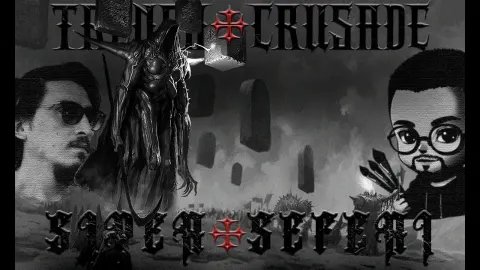
This guide accompanies "Trench Crusade Lore | Tüm Tarihi ve Teçhizatları", a Turkish-language video by 40ip published on 12 June 2025. The narrator walks through the timeline, the weapons and his own translation choices in a deliberately archaic, Ottoman-flavoured Turkish. Rather than repeat the video, we put the events in dated order, collect where each faction sits in the story, and add sourced details the video skips. For rules, gameplay and how to get started, see our companion guide What is Trench Crusade and how do you play it.
What is the Trench Crusade lore about?
Trench Crusade is a miniatures wargame set in a world artist Mike Franchina began designing in 2016, with miniatures developed alongside sculptor James Sherriff. According to Wargamer's lore interview, rules designer Tuomas Pirinen wrote almost the entire timeline.
The premise is simple and grim: history broke in the Middle Ages when Hell opened onto the Earth, and there has been no peace since. Familiar names, places and institutions from real history appear, but every one of them is bent in a new direction. The Church survives but is torn by sectarian wars. The Islamic world unites under a single sultanate. European kingdoms build fortress after fortress against attacks from land and sea. By the early 20th century the war has settled into a First World War style stalemate in the trenches.
Source note: paraphrasing the framing in the official quickstart rules, a heretical order of Templars defied the Almighty during the Crusades, and the war between Heaven and Hell still rages in 1914. Warbands roam No Man's Land gathering information and ancient artefacts, hunting scouts and high-value targets.
What happened in Jerusalem in Trench Crusade?
It starts when the crusader army takes Jerusalem. Beneath the city's holy sites, the Knights Templar find an ancient and dark power in hidden vaults. Greed hollows out their faith; they turn to serving that power, bargain with demons and begin performing rituals. The 40ip video calls this turning point the "First Heresy".
English sources call it the Act of Ultimate Heresy. Through it the gates of Hell open on Earth and Jerusalem is destroyed, leaving a region where Hell and the mortal world bleed into each other. Wikipedia's summary adds that in this setting the Templars were founded in 1072 rather than the historical 1118, and that Hell eventually won roughly a third of humanity to its side.
One point worth stressing: in Trench Crusade "heretic" describes the side that has sworn itself to Hell, not a theological debate. The fiction uses religious figures and institutions but passes no judgment on real faiths. It is a dark alternate-history tale.
What is the Trench Crusade timeline?
The video tells events in sequence without dates. The years below come from a secondary source that relays the official timeline, 421.news's Trench Crusade lore article, so small differences from the official text are possible.
- 1099: Jerusalem falls, the Act of Ultimate Heresy is committed, the gate to Hell opens and the city is destroyed.
- 1101, Year of the Three Battles: Heretics and the armies of Hell take most of the Levant.
- 1102: Antioch is fortified and becomes the heart of the resistance.
- 1109: The Great Sultanate unites the Islamic factions; the Great Iron Wall of Alexander is fortified against the heretics.
- 1165: The Old Man of the Mountain and the Assassins defend Alamut, which holds out through centuries of sieges.
- 1215–1306, Triclavianist Wars: Christendom splits over how many nails were used at the Crucifixion, and millions die. The heretics expand while the faithful fight each other.
- 1346–1353, the Black Grail plague: Beelzebub's plague infects tens of millions.
- 1429: The living saint Joan of Arc drives the Black Grail from mainland Europe.
- 1503: Orichalcum steel is discovered under the guidance of Saint Eligius, patron of metalworkers.
- 1545: Ancient Antioch is destroyed by a mysterious infernal weapon.
- 1573: The Holy Order of the Dragon halts the heretic advance after the fall of Byzantium; the video places this stand in Wallachia.
- 1595: The walls of New Antioch are completed.
- 1666, Year of Six Calamities: The heretic fleet takes Gibraltar and Hell's forces break out into the Atlantic.
- 1670: The English Crown begins building the White Cliffs fortress to guard its coast.
- 1703: The Hebrew Knights raze the Templar fortress at Acre.
- 1805, Battle of the Bloody Cliffs: Heretic High Captain Ranga defeats the English fleet, and Admiral Nelson dies.
- 1866: Heretic scholars aided by the demon Marbas build the first modern submarines. Merchant fleets suffer heavy losses and famine spreads.
- 1894, Year of the Broken Trinity: Heretic assassins kill the High Pontiff, High Prophetess Aelia and the Holy Roman Emperor, and tank-led heretic legions launch a simultaneous blitz across the Levant and Europe.
- 1907: The Moving Fortress of Britannia is completed.
- 1914: The game's present. Both sides prepare for great offensives while raids across No Man's Land for intelligence, relics and key positions grow ever more savage.
Some entries track real European history almost exactly; others are pure invention. Joan of Arc, Nelson and the Order of the Dragon are dropped into a very different story. That "familiar but wrong" feeling is a big part of the appeal: because readers know the real history, they spot each divergence instantly. The Wargamer interview notes that many real historical figures, from Joan of Arc to Catherine of Siena, appear in the setting.
Why is Trench Crusade set in 1914?
The choice is deliberate. The First World War's western front was a stalemate defined by mud, barbed wire and artillery, where neither side could break through. Trench Crusade stretches that deadlock across eight hundred years: demons and humans both wield supernatural power, yet nobody can win. Over the centuries the land around Jerusalem becomes a scar of trenches, ditches and mud.
That is why the game's visual language is built on trench warfare. The table usually represents No Man's Land: shell-cratered ground, abandoned trenches, sandbag positions and lines of wire. If you are building a table, our Siper Hattı trench terrain set matches this setting closely, and pieces like barbed wire and a sandbag set are the classic details of No Man's Land.
Who are the Trench Crusade factions in the story?
The official structure is six core factions plus their warband variants. Their rules and list building belong in our other guide; here we only look at their place in the narrative.
Principality of New Antioch
Rising after ancient Antioch's destruction, New Antioch is the military and political centre of humanity's resistance. In the lore, contingents from the Papal States, Prussia, Ireland, Scotland and Abyssinia gather around it. With riflemen, artillery and foundries, it is the "regular army" of the faithful.
Trench Pilgrims
The Pilgrims are soldiers of faith rather than of an army. More crowd than chain of command, they follow relics and preachers to the front. Groups such as the Procession of the Sacred Affliction turn suffering and self-sacrifice into worship. Fanaticism and heavy piety set their tone.
Iron Sultanate
Formally the Great Sultanate of the Invincible Iron Wall. It unites the factions of the Islamic world and holds the great iron wall attributed to Alexander (Dhul-Qarnayn) as a frontier against Hell's armies. Drawing on Alamut's fida'i, Ottoman-style azeb marksmen and a deep scholarly tradition, it is the faction Turkish players recognise most. It is not a stand-in for any real state but a fictional blend of several historical layers.
Heretic Legion
The army of humans sworn to Hell, carrying the Templars' legacy. They field armour of hellish iron, flamethrowers, tanks and submarines. The fleet that took Gibraltar, the victory at the Bloody Cliffs and the naval raids on Europe belong to them.
Cult of the Black Grail
Corruption organised around Beelzebub's plague. The Black Grail advances more like an epidemic than an army, turning the infected into its carriers. Its horror is disease, flies and rot.
Court of the Seven-Headed Serpent
Hell's nobility and the demonic forces that walk the Earth directly. The heretic legions are humans serving Hell; the Court is Hell itself.
What weapons and equipment are used in Trench Crusade?
Eight centuries of war have produced a hybrid arsenal where ancient and modern sit side by side. A soldier carrying a bolt-action rifle and a mace is perfectly normal here. It reads most clearly when sorted by side.
Common to both trenches
- Bolt-action rifles: the workhorse of the front, common on both sides.
- Melee weapons: armour often stops bullets, so fights end hand to hand. Trench clubs, polearms, maces and slim daggers for finding gaps in armour matter.
- Explosives and gas: grenades, anti-tank lances tipped with explosives, chlorine and mustard gas. Gas masks are standard kit.
- Rare heavy weapons: machine guns and sniper rifles are valuable, limited assets.
The faithful's arsenal
Armourers of New Antioch and its allies trust alloys worked with divine light. Orichalcum steel, discovered in 1503, is expensive but highly effective against ranged fire. Soldiers carry icons, medals and relics believed to turn battles, and "martyrdom pills" that dull pain and fatigue at a heavy cost.
The heretics' arsenal
Heretic power comes from Hell's foundries. Infernal metals outperform mortal steel but wear down the bearer's body and soul and leave wounds that never heal. Flamethrowers, tanks and submarines built with Marbas's knowledge form its modern face. The extreme example is the Mouth of Hell, a colossal gun from those foundries: according to official sources, 666 feet long with a 1666 mm calibre.
Both sides buy advantage at a price; that is the lore's most consistent theme. It also gives painters plenty to work with. Rusted armour, mud-soaked greatcoats and battered clubs suit almost every technique in our rust effects and mud and dirt effects guides.
How are Trench Crusade terms translated into Turkish?
The official rules are published in English and French; we found no official Turkish translation. The video's final section is about localisation: the narrator favours a literary, archaic Turkish over literal translation, arguing that sound and rhythm make a translation hit hard. So "trench" becomes either "hendek" (ditch) or "siper" (trench line) depending on context, and "unholy" becomes his coined "gayri mukaddes". On our Turkish pages we use Hendek Hacıları for Trench Pilgrims, Demir Sultanlık for Iron Sultanate, Kara Kâse for Black Grail and sahipsiz topraklar for No Man's Land.
Frequently asked questions
What year is Trench Crusade set in?
The game's present is 1914. According to the official quickstart rules, the war between Heaven and Hell that began during the Crusades is still raging in 1914. The timeline starts with the fall of Jerusalem and the Act of Ultimate Heresy in 1099.
Who wrote the Trench Crusade lore?
Artist Mike Franchina designed the world. According to Wargamer's interview, rules designer Tuomas Pirinen wrote almost the entire timeline. Franchina's visual world and Pirinen's chronology are the two pillars of the setting.
Is Joan of Arc in Trench Crusade?
Yes, as a living saint. In the timeline she drives Beelzebub's Black Grail plague out of mainland Europe in 1429. Wargamer's interview says other real historical figures, such as Catherine of Siena, also appear.
Who are the Iron Sultanate in Trench Crusade lore?
The Iron Sultanate is a fictional sultanate uniting the factions of the Islamic world behind Alexander's great iron wall. It draws on the Dhul-Qarnayn legend, the Assassins of Alamut and Ottoman military tradition without representing any real state.
What is the Black Grail?
The Black Grail is the plague Beelzebub unleashed on humanity. In the lore it infects tens of millions between 1346 and 1353 and turns its carriers into soldiers of corruption. It is also a playable faction defined by disease, rot and flies.
Is Trench Crusade disrespectful to religion?
The setting borrows figures from Christian and Islamic traditions but judges no real faith. The villains are not a religion but those who have sworn themselves to Hell. It is best read as a dark alternate history aimed at adults.
If the story hooked you, building the table and painting the miniatures is just as rewarding. Browse our painting guides, and join the Karargah to share your questions and your tables.